

As a supplier of Strapping PET, I've witnessed firsthand how different manufacturing processes can significantly influence the quality of our product. In this blog, I'll delve into the various manufacturing methods and their impacts on Strapping PET quality, drawing on my experience in the industry.
Extrusion Process
The extrusion process is one of the most common methods for manufacturing Strapping PET. In this process, PET resin is heated until it becomes molten and then forced through a die to form a continuous strap. The temperature, pressure, and speed during extrusion play crucial roles in determining the quality of the final product.
If the temperature is too high, the PET resin may degrade, leading to a decrease in the strap's strength and durability. On the other hand, if the temperature is too low, the resin may not melt completely, resulting in an uneven strap with weak spots. Similarly, improper pressure and speed can cause issues such as inconsistent thickness and poor surface finish.
A well - controlled extrusion process, however, can produce Strapping PET with excellent mechanical properties. The strap will have a uniform thickness, a smooth surface, and high tensile strength. This makes it suitable for a wide range of applications, from light - duty packaging to heavy - duty industrial strapping. For example, in the shipping industry, high - quality Strapping PET produced through precise extrusion can securely hold large pallets of goods during transit, reducing the risk of damage.
Orientation Process
After extrusion, the Strapping PET often undergoes an orientation process. This involves stretching the strap in one or more directions, which aligns the polymer chains within the PET. Orientation significantly enhances the strap's strength and stiffness.
There are two main types of orientation: uniaxial and biaxial. In uniaxial orientation, the strap is stretched in one direction, typically the machine direction. This results in a strap with high strength in that particular direction but relatively lower strength in the transverse direction. Biaxial orientation, on the other hand, involves stretching the strap in both the machine and transverse directions. This creates a more balanced strap with high strength in multiple directions.
The degree of orientation also affects the quality of the Strapping PET. Over - orientation can make the strap brittle and prone to cracking, especially under stress. Under - orientation, on the other hand, may not provide sufficient strength improvement. A properly oriented Strapping PET will have enhanced resistance to elongation and better recovery properties, which are essential for maintaining tension during long - term use.
Coating Process
Some manufacturers apply a coating to the Strapping PET to improve its performance. Coatings can serve various purposes, such as enhancing the strap's adhesion to the load, providing protection against moisture and chemicals, and improving the strap's appearance.
For example, a wax - based coating can reduce friction between the strap and the dispenser, making it easier to feed the strap during the strapping process. A UV - resistant coating can prevent the strap from deteriorating when exposed to sunlight, which is important for outdoor applications. Additionally, a colored coating can be used for identification purposes, allowing users to easily distinguish between different types of straps.
However, the quality of the coating application is crucial. An uneven or poorly adhered coating can peel off, reducing the effectiveness of the coating and potentially causing issues during use. A well - applied coating should be uniform, durable, and compatible with the PET substrate.
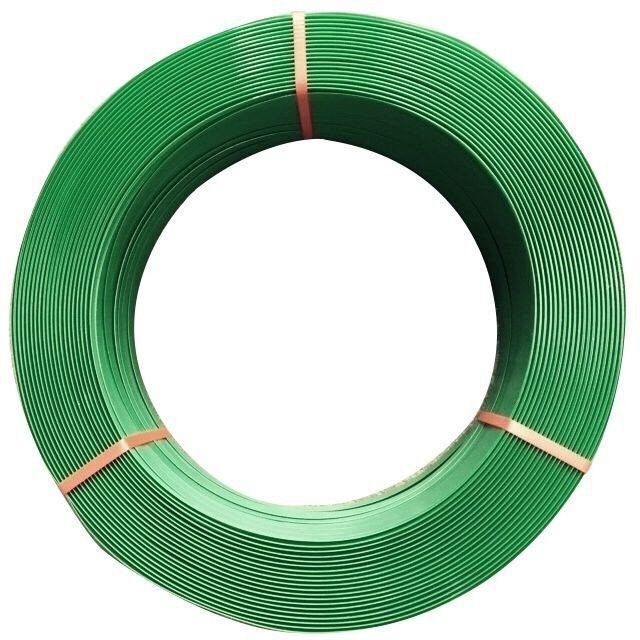

Quality Control in Manufacturing
Regardless of the manufacturing process, strict quality control is essential to ensure the consistent quality of Strapping PET. This includes monitoring the raw materials, the manufacturing parameters, and the final product.
For raw materials, suppliers need to ensure that the PET resin meets the required specifications. This may involve testing the resin for its molecular weight, melt flow index, and other properties. During the manufacturing process, real - time monitoring of temperature, pressure, speed, and other variables can help detect and correct any deviations from the optimal conditions.
Final product testing is also crucial. This can include tests for tensile strength, elongation at break, impact resistance, and thickness uniformity. By conducting these tests regularly, manufacturers can identify any quality issues early and take corrective actions.
Impact on End - Users
The quality of Strapping PET directly impacts end - users. High - quality strapping ensures the safety and security of the packaged goods. It reduces the risk of product damage during handling, storage, and transportation, which can save businesses significant costs.
For example, in the food industry, reliable Strapping PET can prevent packages from opening and keep the food products fresh and intact. In the construction industry, strong and durable strapping can hold building materials together, ensuring the stability of structures during construction.
Moreover, high - quality Strapping PET is more efficient to use. It feeds smoothly through Strapping Dispensers, reducing downtime and increasing productivity. It also requires less maintenance and replacement, resulting in lower overall costs for the end - user.
Conclusion
In conclusion, different manufacturing processes have a profound impact on the quality of Strapping PET. The extrusion process sets the foundation for the strap's basic properties, while the orientation process enhances its strength and stiffness. The coating process can provide additional functionality, and strict quality control ensures consistent quality.
As a Strapping PET supplier, we are committed to using the best manufacturing processes and implementing rigorous quality control measures to provide our customers with high - quality Strapping PET. We understand that the quality of our product is crucial for the success of our customers' businesses.
If you are interested in learning more about our Strapping PET products or have any questions regarding the manufacturing process and quality, please feel free to contact us for a procurement discussion. We look forward to partnering with you to meet your strapping needs.
References
- "Plastic Packaging Technology" by J. P. Lacasse
- "Handbook of Polymer Science and Technology" edited by H. S. Kaufman and J. Falcetta
- Industry reports on PET strapping manufacturing and quality standards.